
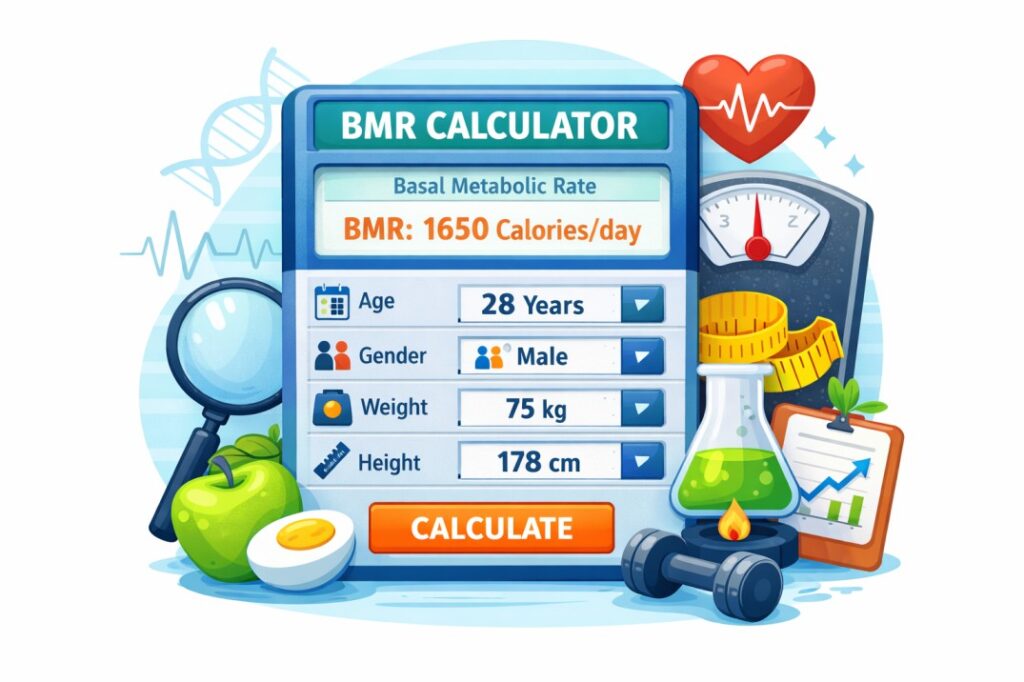
BMR Calculator
Calculate your Basal Metabolic Rate
Your BMR is
This is the number of calories your body burns at rest per day.
Have you ever thought why you need to consume food every day? You might say it is because you feel hungry or your stomach growls. Well, the real answer to this question lies in the energy needs of the body. Your body is like a machine, and thus it needs power to run. And it is interesting that even when you’re sleeping, your body is burning fuel for breathing, pumping the heart, and other functions.
And this sleeping fuel has a specific name, Basal Metabolic Rate, or BMR for short.
To understand how your body works and how it uses energy, you need to know metabolism. It is not as complicated as it sounds. Before you dive into the world of metabolism, let’s explore what BMR is, how to measure it with a BMR calculator, and most importantly, why it matters to you.
What is Basal Metabolic Rate?
Imagine you decided to lie in bed all day long. You’re literally not doing anything even brushing your teeth. You don’t walk to the kitchen or you don’t even face the laptop screen. You just lie there and relaxing. Now, the million-dollar question is: do you think your body would need energy even to lie in bed? Well, interestingly, the answer is yes. Even when you’re doing absolutely nothing, your body is still working hard on the inside. Your heart needs to pump blood, your lungs need to breathe in air, your brain has to think and most importantly, your body has to keep itself warm.
Basal Metabolic Rate is the amount of energy in calories your body needs to stay alive while your body is idle. Let’s understand it by taking an example of a refrigerator in your kitchen and not moving anywhere. Your refrigerator is on until the plug is on. If you unplug, the refrigerator will stop working. Your BMR is the minimum electricity (energy) your body needs so you don’t turn off.
It is interesting to mention that for most people, this doing nothing energy accounts for most of the foods they eat. In other words, BMR uses up to about 60 to 70% of all the calories you burn in a single day. Human body is made up of trillions of tiny living blocks called cells. These cells are like tiny factory workers that never take a vacation. Your Basal Metabolic Rate pays these workers to keep the factory running. Here are the main jobs they do using your BMR:
-
- Breathing and Pumping: For breathing to take place, your chest moves up and down and your heart beats 100,000 times a day. In order to breathe and the heart to pump blood, a lot of power is needed.
-
- The Brain: Brain is one of the most complex and delicate part of the body. In other words, you can call brain as the boss of your body. Even if you are sleeping, your brain is working and managing different organs of your body. The brain uses a huge chunk of your Basal Metabolic Rate energy.
-
- Body Temperature: Have you noticed that your body maintains a steady temperature (about 98.6°F). Even it is cold outside, your BMR has to work harder to make heat so as to maintain a constant body temperature.
-
- Cell Repair: Every day, your body is healing cuts, growing new hair, and replacing old cells with new ones. All these functions require energy.
The BMR Calculator
Now, you know what BMR is and how important it is for you to be alive. The most important question is how do scientists figure out your specific BMR number? You cannot jump inside your stomach and count the calories burning. To figure this out, scientists used math equations. Today, you can easily find a BMR calculator online. A Basal Metabolic Rate calculator asks for specific information about you to guess how much energy your body needs to stay alive. There are four main parameters such as your weight, height, age, and your gender.
There are famous math formulas inside every BMR calculator. One of the most famous ones is called the “Harris-Benedict equation”. It looks really complicated with lots of multiplication and subtraction, but the Basal Metabolic Rate calculator does all the hard math for you.
What Changes Your BMR?
Have you heard someone saying, I have a fast metabolism or I have a slow metabolism? This is actually referring to their BMR. It is important to note that everyone’s Basal Metabolic Rate is different. Here is why your number might be different from your friend’s number:
Muscle vs Fat: People who have big muscles tend to burn more calories even when they are sleeping. That is why, athletes often have a very high BMR. If you exercise daily and build muscles, your BMR will usually go up.
Age: When you are a kid, you are at a growing phase where you are growing taller, your bones are getting thicker, and your brain is learning fast. Because of this growing phase, kids usually have a high BMR for their size. As people grow older and become grandmas and grandpas, their bodies stop growing and they often lose some muscle. This means, their Basal Metabolic Rate goes down, and they don’t need to eat as much food as they used to.
The Weather: Whether you believe it or not, but it is true – yes, weather affects your BMR. For instance, if you live in a cold place, your body needs to burn more fuel to keep you warm. This raises your Basal Metabolic Rate. On the other hand, people who live in very hot, tropical places might have a slightly lower metabolism because their bodies don’t have to work as hard to stay warm.
Hormones: One of the most important glands of your body is the thyroid gland, which is present in the neck region. This special gland releases a hormone that tells your body how fast to burn energy. There are two conditions associated with the thyroid: hyperthyroidism and hypothyroidism. In case of hyperthyroidism, the gland releases more hormones than required, and this results in high BMR, and you might feel hot and shaky. And in case of hypothyroidism, the hormones released are less than normal. This results in low BMR, and you might feel tired and cold.
Why Do You Need to Know the BMR?
You might be thinking, I am strong and healthy, why would I care about a Basal Metabolic Rate calculator. Well, knowing BMR is important for you to stay healthy as you grow up. Here is why:
Energy Balance: The food you consume is the calorie you put in. Your movement and exercise are the calories you spend. If you consume more food than your body requires, that extra calories get stored in the body as fat. On the other hand, if you eat less than your body uses, your body will burn stored fat to get energy.
Knowing your BMR helps doctors and nutritionists keeping you at a healthy weight. BMR tells them how much energy your body needs to stay alive and thus they can figure out how much food your body needs. Whether you’re eating less or too much. And they figure out how to adjust food and activity so that your body stays healthy.
Knowing How Much to Eat: If you are an athlete or a health freak, you will burn a lot of energy every day. And, you would need to eat enough food to cover their BMR. However, if you don’t eat enough, your body won’t have the energy to perform your daily activities. A Basal Metabolic Rate Calculator acts like a base to see how much food you need as a reference point.
Checking Your Health: There are times when you feel tired all the time. And sometimes you might lose weight without doing any activities. Well, in such a situation, your doctor might check your Basal Metabolic Rate. In case the BMR is too low or too high, it could give your doctor a clue that your thyroid gland is not functioning normally.
FAQs (Frequently Asked Questions)
Q. What does basal metabolic rate (BMR) measure?
A. BMR measures the minimum amount of calories your body requires to perform vital activities such as breathing, pumping blood in the heart and cell production, etc.
Q. How does a BMR calculator estimate my calories?
A. BMR calculator uses mathematical formulas that require inputs such as weight, height, age, and gender.
Q. Does having more muscle increase BMR?
A. Yes, muscles are metabolically active than fat tissues. And, that is why, higher muscle mass burns more calories even when you are at a resting stage.
Q. Why does basal metbolic rate decrease with age?
A. BMR generally declines with age because of the natural loss of lean muscle tissue and also because of the slowdown of cellular metabolic activities.
Q. How does my thyroid affect my BMR?
A. Thyroid gland releases T3 and T4 hormones that are directly associated with the speed of your metabolism. Hyperthyroidism increases BMR and hypothyroidism lowers BMR leading to symptoms of weight loss and fatigue.